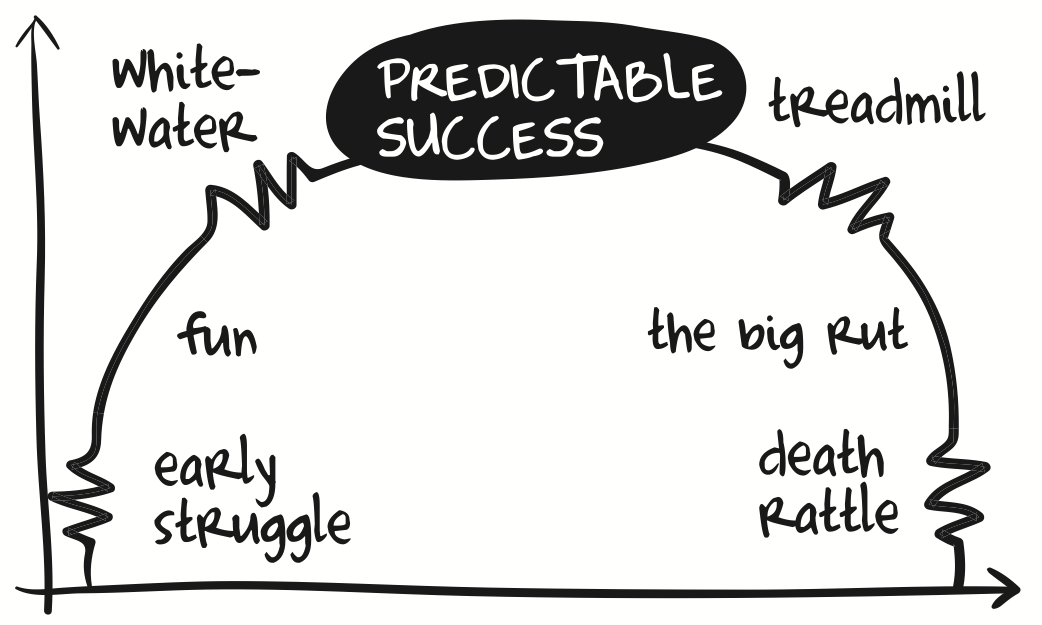
At some point, the friction stops being a leadership problem and becomes a team problem. Silos form. Decisions that should happen in your leadership team still funnel through you. Your people are capable individually — but together, they're not producing what they should.
That's not a people problem. It's a structural one. And it requires a different kind of intervention — one that addresses the whole team, not just the leader.
This isn't a retreat. It's a structured change process — four full-day sessions spaced across roughly a year, with real implementation work happening between each one.
The first full day is the foundation for everything else. Your leadership team takes the Predictable Success assessments before we meet, then we spend the day together — establishing a shared language, surfacing the real dynamics that are holding the team back, and identifying where the organization is stuck on the growth curve. Most teams leave this day surprised by what they learn about themselves and each other. The output is a clear, prioritized picture of the 2–3 structural imperatives your team needs to address.
Full-day · Your leadership teamThe next three days are built around what the diagnostic surfaces. Each full-day intensive works through one of the structural imperatives your team identified — whether that's decision-making clarity, cross-functional alignment, empowerment, accountability, or something else entirely. Between sessions, your team implements. By the time we reconvene, the work is real, not theoretical. Each session builds on the last.
Three full days · Spaced across ~1 yearThe work doesn't stop when the day ends. Between sessions, you have ongoing access to me for questions, calibration, and support as your team implements what we worked on together. Change this significant rarely happens without friction along the way — and you shouldn't have to navigate that alone.
For business owners and CEOs with 45+ employees
Not sure which program fits? Check your symptoms or compare all programs.
Your team has a common language for what's been happening and why. They're no longer guessing — they understand the stage you're in and what it requires of them.
The action plan doesn't come from you. It comes from the team, with your facilitation. That's the difference between a plan that gets implemented and one that gets forgotten.
The right decisions are being made at the right level. Your leaders are collaborating across functions instead of escalating everything to the top.
The structural work done in this engagement is what allows a business to scale beyond its current stage. Not just for now — but as a foundation for what comes next.
Most leadership team offsites are built around energy and alignment. Those things matter. But they don't last without structure — and structure requires a diagnosis first.
The Predictable Success framework, developed by Les McKeown, gives your team a precise map of where the organization is stuck and why. It's research-backed, field-tested across thousands of organizations, and specific enough to actually drive decisions.
I'm a Licensed Predictable Success Partner. That means the diagnostic, the intensives, and the work between sessions are all grounded in this framework — not improvised around whatever surface issue comes up on the day.
The Predictable Success lifecycle — developed by Les McKeown
The Predictable Success accelerator workshop library covers 13 specific organizational imperatives — from org chart clarity and cross-functional alignment to empowerment, accountability, and key transitions.
Every company in Whitewater has friction concentrated in 2 or 3 of them. The Diagnostic Workshop's job is to identify exactly which ones yours are — so the three intensives that follow address your actual bottlenecks, not a generic curriculum.
This is what makes Team Acceleration different from an offsite. We're not covering all 13. We're going deep on the 2–3 that are holding your team back right now.
The Scalability Matrix — 13 imperatives for organizational growth
Who is this program designed for?
Business owners and CEOs with 45 or more employees whose leadership team is misaligned, siloed, or struggling to scale together. If the problem has grown beyond you — if it's your whole leadership team — this is the right program.
How is this different from a leadership retreat?
A retreat generates energy and alignment for a day. Team Acceleration generates structural change over a year. The diagnostic gives us a precise picture of what's actually broken. The intensives address it specifically. And the implementation work between sessions is where the real change happens. Most teams have had plenty of good days together. This is different.
Who from our team needs to attend?
Typically the CEO and their direct leadership team — the people who own the key functions of the business. The exact composition depends on your structure, and we'll talk through what makes sense before the first session.
What happens between the four sessions?
Your team implements. Each intensive produces a clear action plan with specific owners and timelines. Between sessions, you have ongoing access to me for questions and calibration as the work unfolds. The sessions are spaced intentionally to allow real change to happen — not just to give the calendar room.
How is this different from EOS or Traction?
EOS is a strong system, and a lot of companies benefit from it. The difference is in the starting point. EOS prescribes the same operating system to every company regardless of where they are in their growth. Predictable Success diagnoses your stage first — and then tells you which tools to use and in what order. For a company in Whitewater specifically, installing a uniform operating system can add process without relieving the pressure, because the root problem is structural and relational, not operational. Predictable Success also uses a four-style leadership team diagnostic called VOPS — Visionary, Operator, Processor, Synergist — that EOS doesn't have an equivalent of. It's often team dynamics, along with missing systems, that's actually the bottleneck.
Read the full comparison →We're not sure if this or Personal Acceleration is the right fit. How do we know?
The clearest signal is whether the friction is primarily in you or in your team. If decisions still funnel through you and your team of 10–45 is capable but not owning enough, Personal Acceleration is usually the right start. If you have 45 or more people and the leadership team itself is where the dysfunction lives, Team Acceleration is built for that. When in doubt, schedule a conversation.